




Legally reviewed by Jimmy Litle, Managing Attorney. A Deputy District Attorney in the 4th Judicial District from 2013 to 2021, he led the Vehicular Homicide Team, the prosecution unit built entirely on driving cases like the ones covered here.
You probably got the summons on C-470 or one of the arterials the Douglas County Sheriff’s Office patrols through Highlands Ranch, and the deputy told you almost nothing: a court date in Castle Rock, a box to check, a fine schedule that does not explain what the charge does to your license, your insurance, or your record. Here is what the summons does not tell you: how traffic cases from Highlands Ranch are actually classified, pointed, prosecuted, and reduced, with every penalty cited to the current statute on colorado.public.law and the official Colorado Revised Statutes at leg.colorado.gov, so you can verify each number before you decide whether to pay, negotiate, or fight.
Highlands Ranch is one of the largest unincorporated communities in Colorado, and that single fact controls the procedure. There is no Highlands Ranch city government, no Highlands Ranch police department, and no municipal court. Traffic enforcement in the community comes from the Douglas County Sheriff’s Office Patrol Division, which covers unincorporated Douglas County around the clock and operates the Highlands Ranch Substation at 9250 Zotos Drive, where the services run to fingerprinting, evidence, and concealed-handgun permits, not ticket payments. The Sheriff’s Office itself explains that unincorporated Douglas County, including Highlands Ranch, is its patrol responsibility.
Because there is no city court, every contested Highlands Ranch ticket lands in the county court at the Douglas County Courthouse, 4000 Justice Way, Suite 2009, Castle Rock, CO 80109. The courthouse is open Monday through Friday, 7:30 a.m. to 4:30 p.m., its Self Help Center runs weekday hours from 8:30 to 12:30 and 1:30 to 4:00, and weekend bond hearings for people arrested on warrants or criminal traffic matters happen on Saturdays only, at 2:00 p.m. Knowing that Saturday advisement schedule matters if a family member was taken in on a Friday night eluding or hit-and-run arrest: nothing will happen on Sunday.
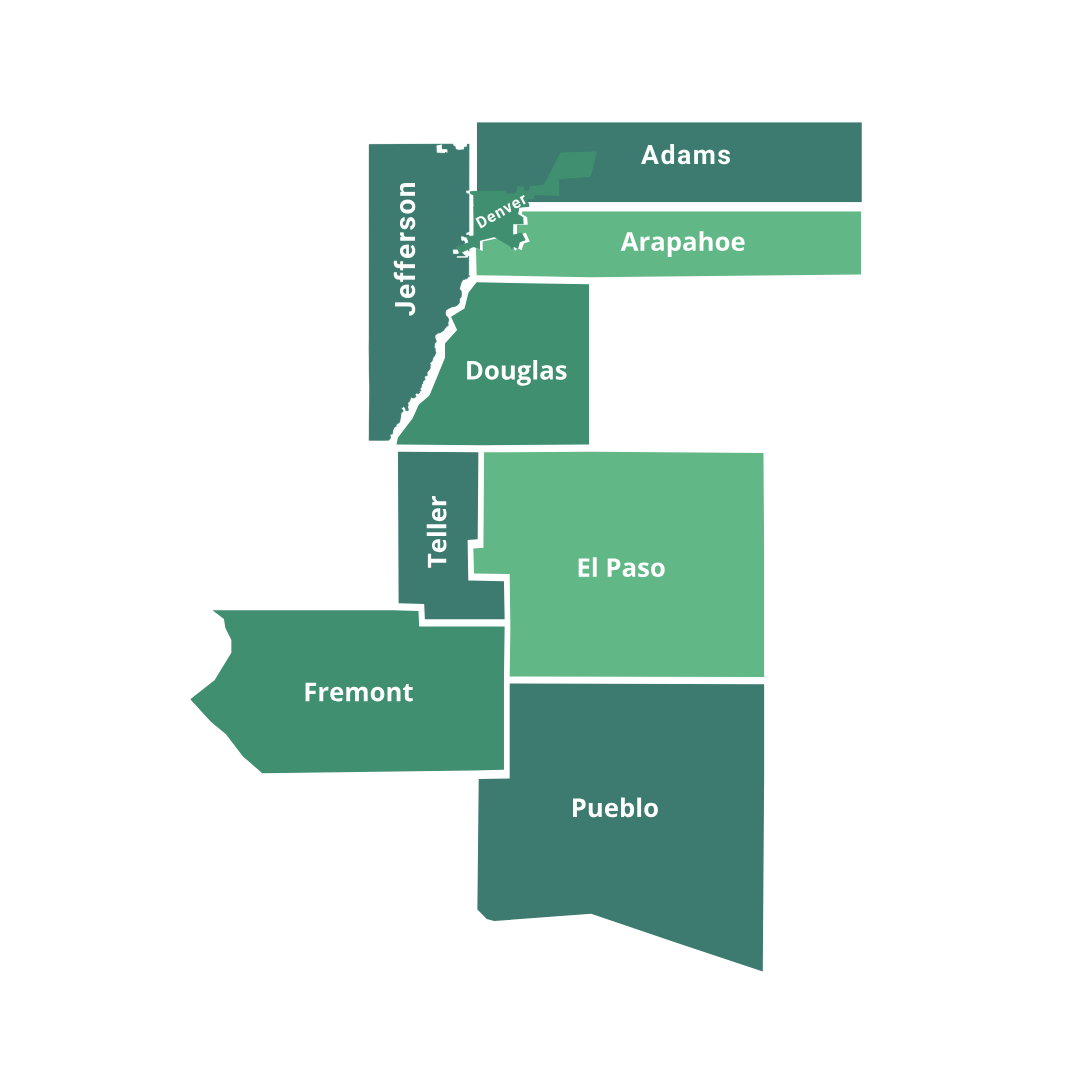
The prosecution side for Douglas County changed in January 2025: Douglas County sits in the new 23rd Judicial District, split off from the old 18th, and its cases are charged by the Office of the District Attorney for the 23rd Judicial District, led by DA George Brauchler, whose Douglas County office sits in the same Justice Way complex as the courthouse, at Suite 2525-A. Misdemeanor traffic offenses from Highlands Ranch are handled by that office’s county court unit. If your citation came from a neighboring incorporated town instead, the path can differ; we also defend drivers in Castle Rock, Lone Tree, and Parker, and our Castle Rock defense page covers the county seat.
The first question a defense lawyer asks about any traffic ticket is which tier it occupies, because the tier sets everything: jail exposure, jury rights, and how hard the DA will hold the line. A traffic infraction is a civil matter, not a crime; a misdemeanor traffic offense is a criminal conviction that follows you. The ranges below are the verified penalty scheme of CRS 42-4-1701(3) (official text), with felony ranges from CRS 18-1.3-401:
| Tier | Civil or criminal | Jail | Fine | Verified examples
|
|---|---|---|---|---|
| Class A or B traffic infraction | Civil | None | $15 to $100 plus surcharge | Speeding 1 to 24 mph over (CRS 42-4-1101); first hands-free violation (CRS 42-4-239) |
| Class 2 misdemeanor traffic offense | Criminal | 10 to 90 days | $150 to $300 | Reckless driving (CRS 42-4-1401); careless driving (CRS 42-4-1402); speeding 25+ over |
| Class 1 misdemeanor traffic offense | Criminal | 10 days to 1 year | $300 to $1,000 | Careless driving causing bodily injury or death; speeding 25+ over in a construction zone; hit and run with non-serious injury (CRS 42-4-1601) |
| Class 4 felony | Criminal | 2 to 6 years | $2,000 to $500,000 | Hit and run causing serious bodily injury |
| Class 3 felony | Criminal | 4 to 12 years | $3,000 to $750,000 | Hit and run causing death |
Two things about that table are worth saying plainly. First, the jump from infraction to class 2 misdemeanor traffic offense is the jump from a fine to a criminal record, and several common charges sit exactly on that line. Second, the same conduct moves tiers based on outcome: careless driving is a class 2 misdemeanor traffic offense on its own, and a class 1 if someone was hurt. The tier fight is therefore the case, and it is winnable more often than drivers assume.
Every conviction posts points to your motor vehicle record under CRS 42-2-127 (official text; hub statute page), and the point-based licensing system suspends licenses on accumulation alone, no matter how minor each individual ticket felt:
| Offense | Points
|
|---|---|
| Speeding 1 to 4 mph over | 0 |
| Speeding 5 to 9 mph over | 1 |
| Speeding 10 to 19 mph over | 4 |
| Speeding 20 to 39 mph over | 6 |
| Speeding 40+ mph over | 12 |
| Careless driving | 4 |
| Reckless driving | 8 |
| Eluding a police officer | 12 |
| Leaving the scene of an accident | 12 |
The suspension thresholds depend on age. An adult is suspended at 12 points in 12 consecutive months or 18 in 24 months. A minor driver between 18 and 21 is suspended at 9 points in 12 months, 12 in 24, or 14 or more points accumulated after turning 18 while under 21. A driver under 18 faces suspension at more than 5 points in 12 months, or more than 6 points accumulated before turning 18. So a single 12-point offense suspends anyone, two 6-point speeding convictions inside a year suspend an adult, and a Highlands Ranch teenager can lose the license over one 10-over ticket plus a careless.
The suspension itself is an administrative act of the DMV, separate from anything the Castle Rock courtroom does, and it has its own process: at a point suspension hearing, a hearing officer decides the restraint length, which can run up to one year, and can grant a probationary license that keeps you driving to work while suspended. That hearing is a real proceeding where preparation changes outcomes, which is why we treat challenging the DMV hearing as part of the defense, not an afterthought. Our attorneys explain the license side in this short video: will a criminal case affect my driver’s license?
Speeding is where most Douglas County traffic files start, and the brackets of CRS 42-4-1101 (official text; hub statute page) do precise work. Driving 1 to 24 mph over the limit is a class A traffic infraction: civil, no jail, fines from the 42-4-1701 schedule ($30 plus a $6 surcharge at 1 to 4 over, $135 plus $16 at 10 to 19 over, $200 plus $32 at 20 to 24 over). At 25 or more over, the charge becomes a class 2 misdemeanor traffic offense, a crime. And 25+ over inside a maintenance, repair, or construction zone is a class 1 misdemeanor traffic offense, the tier with a year of jail exposure. The zone changes the classification, not the points; the point value still follows the speed bracket table above.
The trap in the brackets is the 4-point band. A 10-to-19-over ticket looks routine, but two of them in a year put an adult a third of the way to suspension and put a driver under 21 at the edge of one. Before you pay anything, read our guide to the five things not to do after a Colorado speeding ticket, because payment is a conviction that posts points, and the reduced charge a lawyer can often negotiate on a clean record exists precisely to keep those points off the ledger. Colorado also criminalizes speed exhibitions and street racing separately; if your summons cites CRS 42-4-1105, you are outside ordinary speeding law and should treat it as a criminal case from the first minute.
Colorado’s two workhorse criminal traffic charges differ by one mental state, and the difference is 4 points and a lot of stigma. Reckless driving under CRS 42-4-1401 (official text; hub statute page) means driving with “wanton or a willful disregard for the safety of persons or property”: a conscious choice to run the risk. It is a class 2 misdemeanor traffic offense carrying 8 points, with a first conviction punishable in the 10-to-90-day, $150-to-$300 range and a second or subsequent conviction punishable by $50 to $1,000, 10 days to 6 months in jail, or both, under the statute’s own repeat clause. The mental state, that willful or wanton disregard, is where these cases are fought, because conduct that looks dramatic in a police narrative often reads as mere inattention under cross-examination.
Careless driving under CRS 42-4-1402 (official text; hub statute page) is driving “without due regard for the width, grade, curves, corners, traffic, and use of the streets and highways”, an imprudent-manner standard rather than a conscious one. It is a class 2 misdemeanor traffic offense with 4 points, and it climbs to a class 1 misdemeanor traffic offense when the driving causes bodily injury or death. Careless matters for a second reason: it is the destination charge. The reduction to careless driving is the standard resolution for overcharged reckless cases, and the charge reduction to careless driving shows up constantly at the end of DUI-adjacent and vehicular files, including the wet reckless resolution in alcohol cases. Our statewide reckless driving guide covers the charge in depth, and one of our attorneys walks through fighting serious traffic charges, careless, reckless, and hit and run, in this video.
On January 1, 2025, Colorado’s old texting statute was replaced by a true hands-free law. Under CRS 42-4-239 as rewritten by SB24-065 (official CRS text at leg.colorado.gov; CDOT’s hands-free law page), it is now illegal for any driver, of any age, to physically hold or pin a mobile device to an ear while driving. Watching video and manual texting are covered; a mounted phone used through Bluetooth, CarPlay, or a dashboard cradle is permitted. The offense is a class A traffic infraction, with escalating fines inside a 24-month window: $75 plus a $10 surcharge for a first offense, $150 plus $10 for a second, and $250 plus $10 for a third or later. A first offense carries 2 license suspension points, and, per CDOT, it can be dismissed entirely if the driver shows proof of purchasing a hands-free accessory; repeat offenses bring higher fines and more license points. The statute keeps exemptions for people reporting emergencies, first responders and public safety workers on duty, utility and code enforcement workers, drivers in parked vehicles, and CDL holders operating commercial vehicles.
Two practical notes from the defense side. First, the pre-2025 rule, a $300 fine and 4 points for texting, is gone; the current first-offense numbers are lower but apply to far more conduct, since simply holding the phone at a red light on University Boulevard is banned conduct. The statute pairs that broad ban with an enforcement limit: under CRS 42-4-239(6), an officer may issue the citation only if the device use caused you to drive in a careless and imprudent manner, so the officer’s account of your driving, not just the phone in your hand, is in play in every one of these cases. Second, the hands-free accessory dismissal is a genuine escape hatch for first-time distracted driving citations, and it is exactly the kind of statutory detail a busy county court docket will not volunteer to you.
Some charges that arrive looking like traffic tickets carry felony architecture. The clearest is leaving the scene. CRS 42-4-1601 (official text; hub statute page) requires a driver involved in a crash to stop immediately at the scene, and grades the failure by the harm: an injury crash is a class 1 misdemeanor traffic offense, a crash causing serious bodily injury is a class 4 felony, and a fatal crash is a class 3 felony, with license revocation on conviction and 12 points on the schedule. Leaving the scene of a property-damage-only crash is governed by its own statute. Many times these cases are built from vehicle forensics and accident reconstruction more than from witnesses, which means the defense often starts before charges are even filed.
Eluding a police officer posts 12 points by itself, enough to suspend any license on one conviction. And when a crash involves alcohol, drugs, or injury, the file leaves traffic court entirely: vehicular assault under CRS 18-3-205 is a felony we cover on our vehicular assault page, with vehicular homicide beyond it, and DUI and DWAI under CRS 42-4-1301 carry their own penalty scheme and a separate DMV track through the express consent hearing, on a clock measured in days after arrest. If your first alcohol case is the reason you are reading this, start with our first DUI in Colorado guide; if the charge is felony-level, our Colorado felony defense page explains that track.
For repeat-ticket drivers, the criminal penalty is rarely the real danger; the danger is habitual traffic offender status. Under CRS 42-2-202 (official text; hub statute page), a driver becomes an HTO by accumulating, within 7 years, any combination of three convictions from the statute’s major-offense list, which includes DUI, DUI per se, or DWAI; reckless driving; driving under restraint; vehicular assault or homicide; making a false affidavit; and hit and run under 42-4-1601. There are two accumulation routes as well: 10 or more convictions of 4-point-or-higher offenses inside 5 years, or 18 or more convictions of 3-point-or-fewer offenses inside 5 years. Once the definition is met, the statute that follows is blunt: the department “shall immediately revoke the license”. The revocation is mandatory, and driving during it, driving under revocation under CRS 42-2-138, with an aggravated form for HTO drivers, digs the hole deeper.
Here is why this matters on an ordinary Highlands Ranch reckless ticket: reckless driving is a major offense on the HTO list. A driver with a DUI from four years ago and a reckless conviction today is one conviction from mandatory revocation, which turns a negotiable class 2 misdemeanor traffic offense into a decision with a seven-year shadow. Counting your convictions before pleading is not paranoia; it is the whole game for anyone with history.
Careless driving is where serious traffic and vehicular files go when the defense works, and these are a few of the many we have resolved, each with the attorney who handled it:
Disclaimer: past results do not guarantee future outcomes; each case is unique and results depend on the specific facts and circumstances. These results are drawn from the firm’s Colorado practice as a whole. More are on our case studies page, and our client reviews include 600+ five-star Google reviews.
Between 2013 and 2021, our attorneys, including the author Jimmy Litle, wrote and reviewed charging decisions as Deputy District Attorneys, and that lens changes how this firm reads a Douglas County traffic file. A county court prosecutor evaluating a contested ticket weighs a short list: the driving record in front of them, whether the citing law enforcement officer will actually appear if the case is set for trial, whether the speed measurement or the narrative has proof problems, and what their office’s going rate is for a driver with your history. None of that list is about how sorry you are, and all of it is movable. A clean record argues for an infraction-level or 0-point resolution; a reasonable suspicion problem with the stop itself argues for suppression; a thin injury allegation argues the class 1 careless count back down to a class 2. That is the practical content of hiring former prosecutors, and it is done by our RLG criminal defense attorneys: Alexis Austin Litle, Jimmy Litle, Gannon Becker, and Zoe Levesque, profiled with the whole Colorado defense team.
A criminal traffic case out of Highlands Ranch follows a compact arc, and most of them, in our experience and in the firm’s client Q&A, resolve in one to two court dates:
Out-of-state drivers get one specific reassurance: as our attorneys put it, points themselves do not transfer between states, though the conviction reports to your home state through interstate compacts, and some states then apply their own rules. The details are in our guide to getting a Colorado ticket as an out-of-state driver and this short video on out-of-state license points. Commercial drivers should treat every Colorado ticket as a career matter: CDL consequences run on their own federal track, and a “minor” 4-point plea that a private driver would accept can be the wrong resolution for a professional. And if your matter is in a different court, our traffic offenses overview and city pages for Colorado Springs traffic defense and the Colorado Springs county court cover the 4th Judicial District side of our practice, while our Highlands Ranch criminal defense page covers non-traffic charges here at home. Misdemeanor-level charges outside the traffic code are covered on our Colorado misdemeanor defense page.
The worst outcomes in Douglas County traffic court happen by default: the fine gets paid, the points post, the second ticket a year later triggers the suspension nobody saw coming. Every number above is checkable, and so is the alternative. Call Right Law Group at 719-822-6227, any hour, or book a free consultation; if you searched for a traffic lawyer near me with a free consultation, that is what this is. Offices in Colorado Springs, Castle Rock, and Highlands Ranch, defending drivers across Douglas County and the 23rd Judicial District.
Usually not before checking the point math. Paying the fine is a guilty plea and a conviction: the points post to your record, your insurer sees it, and it counts toward the 12-in-12-months suspension threshold of CRS 42-2-127.
The payment option exists because it is efficient for the system, not because it is good for you. A 10-to-19-over speeding ticket is 4 points; two of those in a year put an adult a third of the way to suspension and put a driver under 21 within one ticket of losing the license. A negotiated resolution that trades the charge down a bracket, or to a 0-point disposition, costs effort now and saves the record permanently. Once paid, the conviction is done, and there is no negotiation left to have.
Before paying anything, pull your motor vehicle record, count your points in the last 12 and 24 months, and get a consultation; ours is free and takes minutes.
Related: driver’s license points, 5 things not to do after a speeding ticket.
It depends on the bracket: 0 points at 1 to 4 mph over, 1 point at 5 to 9 over, 4 points at 10 to 19 over, 6 points at 20 to 39 over, and 12 points at 40 or more over, under CRS 42-2-127.
The brackets mean the difference between 9 over and 10 over is the difference between a forgettable ticket and a third of an adult suspension. The 12-point bracket at 40+ over suspends any license on a single conviction, and at 25 or more over the limit the charge is also criminal rather than civil under CRS 42-4-1101, so the point problem and a misdemeanor traffic record arrive together.
Check the charged speed against the radar or lidar evidence before accepting anything; bracket-edge tickets are exactly where measurement challenges and negotiated reductions pay off.
Related: CRS 42-2-127, point-based licensing system.
Under the penalty schedule of CRS 42-4-1701, common brackets run $30 plus a $6 surcharge at 1 to 4 over, $135 plus $16 at 10 to 19 over, and $200 plus $32 at 20 to 24 over the limit.
The fine is the smallest cost. The points drive insurance surcharges for years, and at 25 or more over the limit the case stops being a fine schedule matter at all: it becomes a class 2 misdemeanor traffic offense with jail exposure of 10 to 90 days, and a class 1 in a construction zone. That is why two tickets with similar dollar figures can have wildly different real prices.
Read the summons for the exact charged bracket and classification before deciding anything, and price the points, not the fine.
Related: CRS 42-4-1101 speeding statute, traffic ticket.
Dismissals come from proof problems and negotiation, not from explanations at the podium: a stop the deputy cannot justify, a speed measurement that fails scrutiny, a missing witness at trial, or a prosecutor persuaded to resolve the case another way.
The state has to prove the speed. Radar and lidar evidence depends on operator training, calibration records, and identification of your vehicle in traffic, and each is a real line of attack in the right case. Separately, county court prosecutors resolve clean-record cases with reductions every day because trying every ticket is impossible. A dismissal outright is rarer than a reduction to a lower bracket or a 0-point disposition, but both beat the conviction you get by paying.
Hiring your Highlands Ranch Traffic Defense Attorney early gives you the best chance at getting a dismissal.
Related: traffic stop legality, evidence suppression.
No. Reckless driving under CRS 42-4-1401 is a class 2 misdemeanor traffic offense, a crime but not a felony. It becomes felony territory only when paired with injury-based charges like vehicular assault.
The confusion comes from how serious the charge feels: 8 points, a criminal record, 10 to 90 days of jail exposure on a first conviction, and $50 to $1,000 with up to 6 months on a repeat. It is also a major offense under the habitual traffic offender statute, so it counts toward mandatory license revocation. But the charge itself stays in county court as a misdemeanor traffic offense, with full criminal trial rights.
If your reckless charge accompanies an injury crash or an alcohol allegation, treat the case as the felony-track matter it may become and get counsel before the first appearance.
Related: reckless driving concept, Colorado reckless driving guide.
Eight points under CRS 42-2-127, the highest point value short of the 12-point offenses like 40+ speeding, eluding, and leaving the scene of an accident.
Eight points does not by itself suspend an adult license, but it is two-thirds of the 12-in-12-months threshold in one conviction, leaving an adult one minor ticket from the line; for a driver 18 to 21 it sits one point from the 9-in-12 threshold, and for a driver under 18 it is past the more-than-5-points line and an automatic suspension. It also arrives with a criminal conviction attached, unlike a speeding infraction, and it sits on the habitual traffic offender major-offense list, where three majors in seven years mean mandatory revocation. That combination is why reckless counts are so often the target of negotiation rather than a plea.
The standard defense move is arguing the mental state down from willful disregard to ordinary carelessness, which cuts the points in half and removes the charge from the HTO list.
Related: willful or wanton disregard, careless driving reduction.
Driving “without due regard for the width, grade, curves, corners, traffic, and use of the streets and highways” under CRS 42-4-1402. It is a class 2 misdemeanor traffic offense carrying 4 points, rising to a class 1 misdemeanor traffic offense if the driving causes bodily injury or death.
Careless driving is the most common serious ticket in Colorado practice because it fits almost any crash: the standard is imprudence, not intent. That breadth cuts both ways. Prosecutors charge it readily after accidents, and defense lawyers use it as the landing spot for reductions, since it carries half the points of reckless and no place on the habitual traffic offender list. The class 1 injury version is a genuinely serious charge with up to a year of jail exposure.
If you were charged with careless after a crash in Highlands Ranch, the fight is usually over the injury classification and fault, so preserve photos, dashcam footage, and witness names immediately.
Related: careless driving concept, CRS 42-4-1402.
The mental state. Reckless driving requires wanton or willful disregard for safety, a conscious decision to run the risk; careless driving requires only an imprudent lapse. Reckless is 8 points; careless is 4.
In our attorneys’ framing from client consultations, reckless is the step above careless: same class 2 misdemeanor traffic offense tier on a first offense, but double the points, a repeat-offense clause with up to 6 months of jail, and membership on the habitual traffic offender major list that careless does not have. The factual line between them is genuinely blurry, which is exactly why the charge is negotiable: the same lane-weave reads as conscious risk-taking in a police report and as momentary inattention in a courtroom.
If you are charged with reckless, the careless reduction is the first question to evaluate, and the record you bring to court determines how realistic it is.
Related: fighting serious traffic offenses video, misdemeanor traffic offense.
The points count against the suspension windows of CRS 42-2-127: 12 points in 12 consecutive months or 18 in 24 months for an adult, with tighter windows for drivers under 21. The conviction itself remains on your motor vehicle record beyond those windows.
The 4 careless points, in other words, are dangerous in combination rather than alone. They matter most inside the 12- and 24-month accumulation windows, where they stack with any speeding or hands-free points you already carry, and they stay visible to insurers and to prosecutors pricing your next case after the suspension math has moved on. A later charge is always negotiated against the record you have built.
Count backward 12 and 24 months from today before resolving any new ticket, because the same plea can be harmless for one driver and a suspension trigger for another.
Related: DMV concept page, point suspension and reinstatement at the Colorado DMV.
Since January 1, 2025, CRS 42-4-239 bans holding or pinning a mobile device to your ear while driving, for all drivers. A first offense is a class A traffic infraction: $75 plus a $10 surcharge and 2 license suspension points.
The law replaced the old texting statute, so the pre-2025 $300-and-4-points figure no longer applies. Fines escalate within 24 months, $150 plus $10 for a second offense and $250 plus $10 for a third or later, and repeat offenses bring more license points. Hands-free use through Bluetooth, CarPlay, Android Auto, or a mount is legal, and exemptions cover emergencies, on-duty first responders, utility workers, parked vehicles, and CDL drivers in commercial vehicles. Per CDOT, a first offense can be dismissed with proof of purchasing a hands-free accessory.
If you got a hands-free citation, buy the accessory before your court date and bring the receipt; the dismissal path is written into the enforcement scheme.
Related: CDOT hands-free law page, distracted driving concept.
You are answerable to the Douglas County Court in Castle Rock like any Colorado driver, and ignoring the summons risks a default judgment or a warrant depending on the charge level. The points, however, do not transfer as points.
As our attorneys explain it, points themselves do not transfer between states; Colorado reports the conviction to your home state through interstate compacts, and your home state decides what to do with it under its own rules, with some states assessing nothing for out-of-state infractions. An attorney can appear on your behalf in many Colorado traffic matters, which often means resolving the case without you flying back.
Do not pay the ticket reflexively just because you live far away; a conviction follows you home, and remote resolution through counsel is usually available.
Related: out-of-state ticket guide, out-of-state points video.
It depends on the charge tier. Payable infractions can be resolved by payment, though that is a conviction with points. Misdemeanor traffic offenses like reckless, careless, and 25+ speeding require an appearance in the Douglas County Court.
Because Highlands Ranch is unincorporated, there is no municipal court option; everything runs through the county courthouse at 4000 Justice Way in Castle Rock, weekdays 7:30 a.m. to 4:30 p.m. The summons states your date and division. For many misdemeanor traffic matters, a retained attorney can handle settings and negotiation with the DA’s county court unit so that your own appearances are minimized, and for infractions counsel can often resolve the matter entirely.
Never simply skip the date: failures to appear convert small cases into warrants and license holds. If the date is a problem, continuances exist and counsel can request them.
Related: Douglas County Courthouse information, municipal court concept.
Rarely, and never before seeing the evidence and counting your points. A guilty plea at the first appearance takes the earliest, least-informed deal available and waives every challenge to the stop, the measurement, and the charge tier.
The first appearance is designed for advisement, not for final decisions. Nothing about your case improves by resolving it in the first ten minutes: the DA’s county court unit has not yet shown its evidence, no one has evaluated whether the reckless count should really be a careless, and the point consequences have not been mapped against your record. Colorado traffic negotiation happens between settings, and the going rate for a clean-record driver is almost always better than the podium plea.
Enter a not-guilty posture, take the next setting, and use the time to get the record, the evidence, and hire your attorneyl; the plea will still be there if it turns out to be right.
Related: arraignment, plea bargain concept.
The Douglas County Court at the Douglas County Courthouse, 4000 Justice Way, Castle Rock, CO 80109, in the 23rd Judicial District. Highlands Ranch has no court of its own because it is unincorporated Douglas County.
Prosecution comes from the 23rd Judicial District DA’s office, whose Douglas County office and county court unit sit in the same Justice Way complex, and whose district, created in January 2025, covers Douglas, Elbert, and Lincoln Counties under DA George Brauchler. Tickets are written mostly by the Douglas County Sheriff’s Office, which patrols Highlands Ranch from its substation at 9250 Zotos Drive, and by the Colorado State Patrol on the highways.
Verify any court date through the Colorado Judicial Branch rather than word of mouth, and arrive early: courthouse security lines on docket mornings are real.
Related: Douglas County hub page, 23rd Judicial District DA’s office.
For an adult, 12 points in 12 consecutive months or 18 points in 24 months. Drivers 18 to 21 are suspended at 9 in 12, 12 in 24, or 14 or more points accumulated after turning 18 while under 21, and drivers under 18 at more than 5 points in 12 months or more than 6 before turning 18.
The thresholds in CRS 42-2-127 make single convictions decisive for young drivers: one 6-point speeding ticket suspends no adult but ends a 17-year-old’s license, and a 12-point offense, 40+ speeding, eluding, or leaving the scene, suspends anyone. The counting windows are consecutive months, so a point that is harmless in isolation can be the tipping point when it lands inside the wrong 12-month stretch.
Pull your motor vehicle record before resolving any ticket; defense decisions should be made against your actual point total, not your memory of it.
Related: point-based licensing system, driver’s license points.
A DMV hearing officer reviews your record, decides whether suspension is required, sets the restraint length, up to one year, and can grant a probationary license that lets you keep driving for work, school, or medical needs during the suspension.
The hearing is administrative and separate from any court case, which surprises people: beating or reducing the ticket helps because it changes the record the hearing officer sees, but once the points are posted, the hearing is its own contest. Preparation matters there: employment evidence, driving-need documentation, and a coherent presentation of your record measurably change both the restraint length and the probationary license decision. This is a proceeding where represented drivers do better.
Request the hearing rather than defaulting into suspension, and treat it with the seriousness of a court date; the license you keep is decided there.
Related: DMV hearing challenge strategy, Colorado DMV suspension page.
A driver who, under CRS 42-2-202, accumulates within 7 years three separate convictions from the major-offense list, which includes DUI, DUI per se, or DWAI; reckless driving; driving under restraint; vehicular assault or homicide; false affidavit; and hit and run.
Two accumulation routes also qualify: 10 or more convictions of 4-point-or-greater offenses within 5 years, or 18 or more convictions of 3-point-or-fewer offenses within 5 years. Once the definition is met, revocation is mandatory; the statute directs that the department immediately revoke the license. The practical trap is that ordinary charges, a reckless plea here, a DWAI there, quietly build the predicate, and nobody warns you at the second conviction that a third means revocation.
If you have any prior major conviction, count before you plead to anything new, and tell your lawyer the full history at the first meeting.
Related: habitual traffic offender concept, CRS 42-2-202.
Driving under restraint is its own criminal charge under CRS 42-2-138, it appears on the habitual traffic offender major-offense list, and for HTO drivers an aggravated version of the offense exists under CRS 42-2-206.
The charge converts a paperwork problem into a criminal record and feeds the HTO machinery: driving under restraint is one of the majors that counts toward mandatory revocation, so a suspended driver who keeps driving is stacking predicates. It also reliably poisons negotiations on whatever new ticket triggered the stop, because the DA now sees a driver who ignored a restraint.
If your license is suspended, the productive move is the reinstatement and probationary license track through the DMV, not risk-managed driving; and if you are already charged, do not resolve the case without counting its HTO consequences.
Related: driving under restraint concept, CRS 42-2-138.
Graded by harm under CRS 42-4-1601: leaving the scene of an injury crash is a class 1 misdemeanor traffic offense; serious bodily injury makes it a class 4 felony with a 2-to-6-year presumptive range; death makes it a class 3 felony at 4 to 12 years, plus license revocation and 12 points.
The duty is to stop immediately at the scene, and the charge punishes the leaving, not the crash: a driver with zero fault for the collision can still be convicted for driving away. Property-damage-only scenes are governed by a separate statute with duties to locate and notify. These cases are typically built on vehicle forensics, paint transfer, and camera canvasses, which means early defense work, before an interview happens, has outsized value.
If you think you left a scene, talk to a lawyer before you talk to the investigating deputy; the first statement usually decides these cases.
Related: CRS 42-4-1601, accident reconstruction concept.
Sometimes. The resolution defense lawyers call a wet reckless, a DUI count resolved as reckless driving with the alcohol noted, is a recognized charge bargain in Colorado practice, dependent on the evidence and the DA’s policies.
Whether it is available turns on the usual pricing inputs: the test result, the legality of the stop, the driving observed, and your history. Our linked results above show the adjacent and sometimes better outcome, DUI counts dismissed or resolved to careless driving, in the right factual posture. Every alcohol case also has a second front at the DMV through the express consent process, which runs on its own short clock after arrest and is not resolved by the criminal plea.
If you face a DUI or DWAI, evaluate both tracks together from day one; a good criminal resolution can still leave a license problem if the DMV side was ignored.
Related: wet reckless concept, DUI charge page, express consent hearing.
For any criminal traffic charge, almost always; for infractions, whenever the points threaten your license, your insurance, or a professional need to drive. The consultation that answers the question costs nothing.
The value is concrete rather than rhetorical: knowing which charges the 23rd Judicial District’s county court unit will reduce and to what, which stop and measurement problems create suppression risk the DA must price, and what your point ledger can absorb. A lawyer also converts many appearances into filings you never attend. Against that, an unrepresented driver typically chooses between paying, a conviction with points, and negotiating without knowing the going rate.
Bring your motor vehicle record and the summons to a free consultation and ask one question: what does this ticket cost me over three years? The answer usually makes the decision.
Related: free consultation, Colorado defense team.
By attacking proof and negotiating tier: challenging the stop’s legality and the speed measurement, testing whether the mental state supports the charged offense, and trading the charge down to a lower bracket, a careless count, or a 0-point disposition.
Each lever is specific. A stop needs reasonable suspicion; a radar reading needs operator training and calibration; a reckless count needs willful disregard rather than a lapse; a class 1 careless count needs proof the driving caused the injury. County court prosecutors carry heavy dockets and price cases on trial risk and record, which is why organized, evidence-based negotiation moves outcomes that podium apologies never move.
The sequence matters: evidence first, negotiation second, trial posture always preserved. A lawyer who begins by asking for mercy has already conceded the case.
Related: probable cause concept, plea bargaining process.
Less than most people fear and, where a license or insurance rating is on the line, usually less than the multi-year cost of the conviction. Fees vary with the charge tier; the consultation is free and produces a fixed quote.
The comparison that matters is against the alternative: a points-bearing conviction raises insurance for years, a suspension has cascading work and family costs, and a criminal traffic record prices into any future case. Our fee structure discussion in the DUI cost guide explains how defense pricing works generally, and traffic matters sit at the lower end of that range.
Get the quote before deciding you cannot afford representation; the number is usually smaller than the three-year cost of the points.
Related: free consultation, reviews from past clients.
Most traffic matters resolve in one to two court dates, in our firm’s experience answering exactly this client question. Contested cases with motions or a trial setting run longer, typically a few months.
The first setting handles advisement and usually opens negotiation; many cases end there with a negotiated plea or reduction. A second setting finishes most of the rest. What extends a case is litigation worth doing: a suppression motion over the stop, a trial where the deputy’s appearance is uncertain, or an injury-classification fight in a careless case. Extension is not a cost when each added month is buying a materially better resolution.
Plan around the summons date, and let your lawyer handle continuances; a rushed plea at the first appearance is the most common self-inflicted wound in traffic court.
Related: arraignment process, reduced charge concept.
Frequently Asked Questions
While you may be tempted to simply pay your ticket and move on, there are many situations where it makes sense to hire an attorney to fight the ticket for you. If you do not feel you deserve the ticket, if the ticket carries a high point value, if your insurance prices will go up, or if you might lose your license, you should absolutely speak with an experienced traffic lawyer before making a decision on how to proceed.
Depending on the particular situation, a traffic attorney will try to either negotiate the ticket or get it dropped altogether. If you were stopped illegally or if the police made a mistake, there may be grounds for dismissing the ticket.
Technically, you may not be required to go to court for a traffic ticket. You may be able to simply pay the ticket and be done with it. That being said, you may be able to get a more favorable outcome for your situation if you do go to court and argue your case. Your best chance in traffic court, however, is to hire a traffic lawyer to represent you.
Generally, if you are trying to fight a traffic ticket, you should always plead not guilty. That being said, every situation is different, and before you decide how to plead for your particular case, you should always speak with a traffic lawyer.
The answer to that question often depends on your particular situation and your personal driving history. Of course, each case is different, and you may or may not have factors involved in your case that would allow it to be dismissed or reduced to a lesser charge. The only way to know for sure is to contact us today for a free, 100% honest assessment of your situation. Payment plans are available. Contact us today to learn more.